

MuleSoft to Workato Migration: Health Plan Scheduling API
September 2, 2026MuleSoft to Workato Migration: Health Plan Scheduling API
September 2, 2026
Sales Call Scoring, Automated: Introducing Our Genie
Every scaling revenue team has the same blind spot. The calls all get recorded. Almost none of them get reviewed. A rep wraps a discovery call that felt great, and nobody catches the moment the prospect said their current tool "sort of works, we just live with the workarounds." The rep moved on without asking what those workarounds cost. Three weeks later the deal stalls, and that single line is the reason.
With five reps, a manager could shadow enough calls to stay honest about quality. After a raise or an acquisition, you have thirty reps, or a recruiting floor where every placement rides on back-to-back candidate calls, and the arithmetic stops working.
Sales call scoring closes that gap by handing the review to an AI agent. Every qualified call gets read, scored against one fixed methodology, and turned into a structured record a manager can coach from.
AI-native review for discovery and proposal calls
The Sales Call Analysis Genie is an AI-native assistant, powered by Anthropic's Claude, that reviews every qualified discovery and proposal call. It scores the conversation against a structured selling methodology, pulls out the objections, buying signals, competitor mentions and loss risks buried in the transcript, and produces a full scorecard for each call: an executive summary, the rep's strengths, their improvement areas and recommended next steps.
Transcripts arrive from the call recorder your team already uses, including Gong, Zoom and Dialpad. Reps change nothing about the way they run calls.
VALUE: the five dimensions behind every score
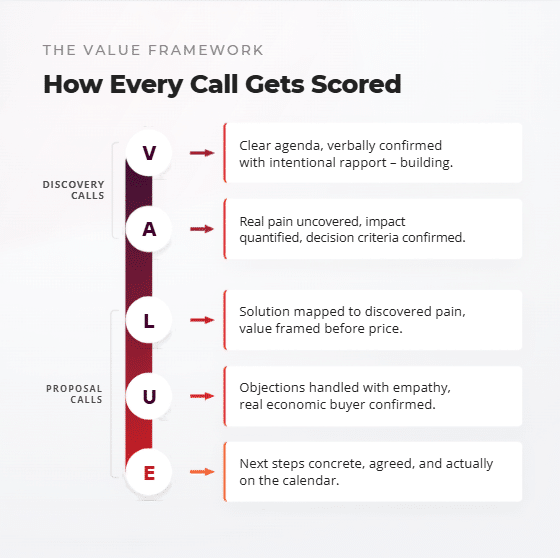
VALUE is the default scoring rubric, and its five dimensions split across the two call types that carry the most deal risk.
Discovery calls are scored on a clear agenda, verbally confirmed, with deliberate rapport building, and on whether real pain surfaced, got quantified, and connected to confirmed decision criteria.
Proposal calls are scored on the solution being mapped to the pain that discovery actually uncovered, value framed ahead of price, objections handled with empathy and the economic buyer confirmed, and next steps that are concrete, agreed and already on a calendar.
Because every rep is measured against the same rubric, each score traces back to a specific moment in the conversation rather than a manager's overall read of the call.
Manual call review runs out of hours before it runs out of calls
Managers skip call reviews because of arithmetic, not indifference. Each week produces more calls than there are hours to listen to them. Whether your reps close SaaS deals, work a distribution desk or fill roles off back-to-back candidate calls, that shortage opens the same four gaps:
- Coverage. Managers sample a few calls a week. The rest go unheard by anyone, so most of what your team says to prospects stays invisible.
- Consistency. When a call does get reviewed, the feedback depends on which manager caught it, and on their mood and bandwidth that day.
- Timing. Call quality can slide for weeks before anyone notices, usually surfacing in a deal review once the deal is already lost.
- Memory. Even a good review lives in someone's head. There is no structured record to coach from, trend over time, or roll into pipeline reporting.
The gap widens fastest right after a team scales
For a revenue org that just doubled headcount, or a talent firm running dozens of desks, the memory problem is the expensive one. The signal that would sharpen your forecast and your coaching sits in the transcripts, and nobody has the hours to pull it out.
From transcript to scorecard in three automated steps
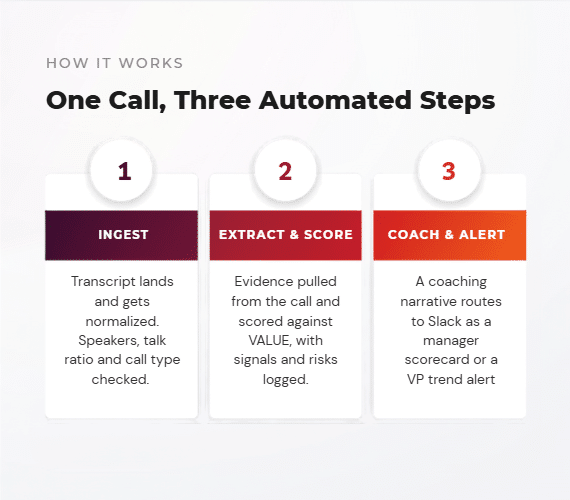
The moment a transcript lands, three automated steps take over. Nobody presses a button or assigns a reviewer.
The transcript gets ingested and normalized, with speakers, talk ratio and call type checked. Evidence is then extracted from the call and scored against VALUE, with signals and risks logged. A coaching narrative routes out at the end, reaching a manager as a scorecard or a leader as a trend alert.
Scoring that points back to the moment it came from
The scoring step is the one manual review can never match at scale. The Genie reads the full transcript, credits what the rep did well, and flags what they missed, such as a named pain point that never got quantified or a decision process that was never confirmed. That offhand line about living with workarounds gets logged as exactly the kind of buying signal a busy rep tends to walk past.
The full pipeline runs on Workato
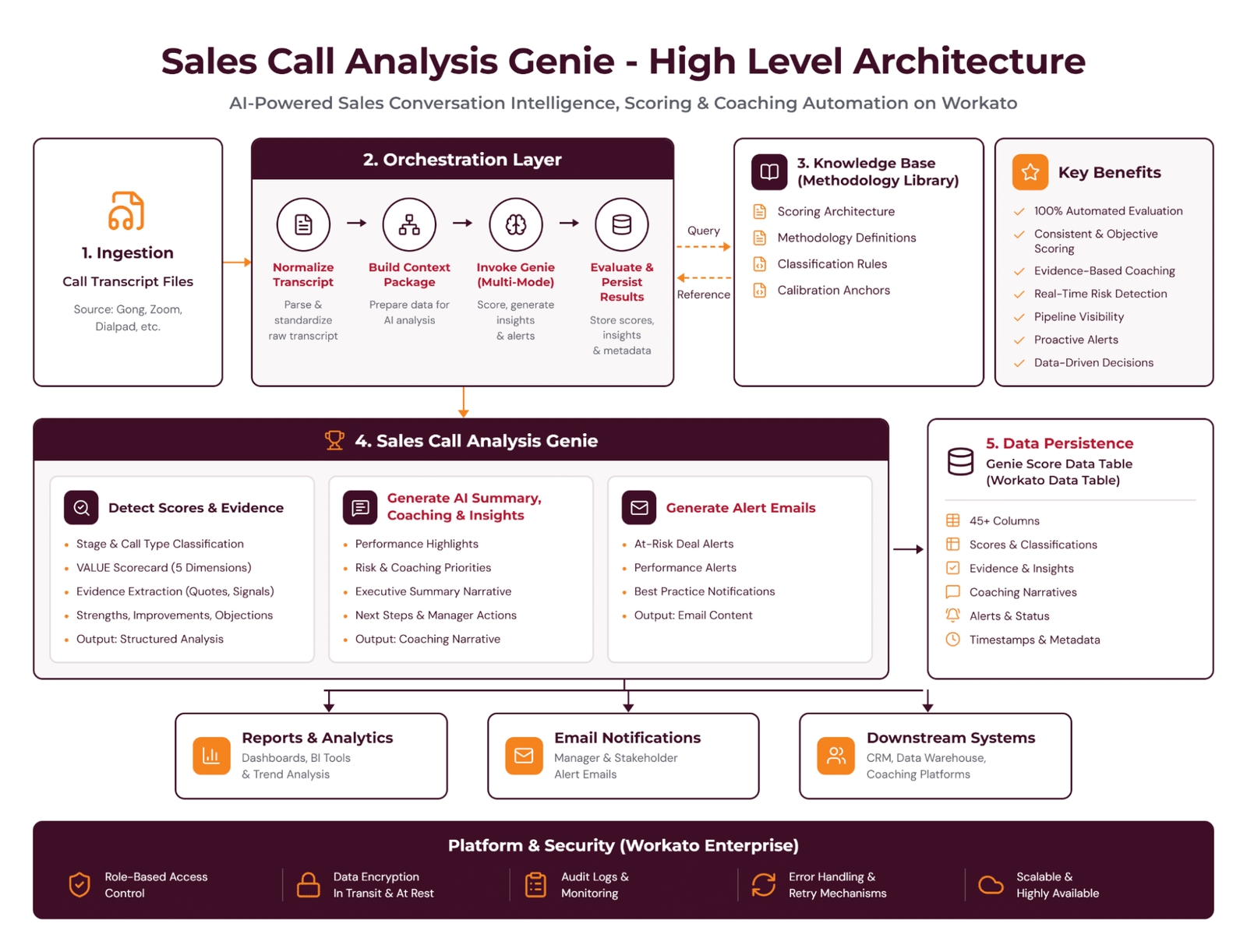
Every stage sits on Workato, from the call-recording tools on the left to the alerts and dashboards on the right. An orchestration layer normalizes the transcript, builds the context package, invokes the Genie and persists the result. A methodology library holds the scoring architecture, methodology definitions, classification rules and calibration anchors that keep scores comparable across reps and across quarters.
Every scorecard, quote, alert and timestamp lands in a Workato Data Table with more than forty-five columns. That is what makes the output usable in your BI tool, your CRM and your pipeline reviews, instead of trapping it in an email thread.
Swapping the methodology without rebuilding the Genie
One design decision matters more than the rest. The methodology is decoupled from the engine. VALUE ships as the default, and MEDDPICC, SPIN, Challenger or your own proprietary framework can live in the Knowledge Base instead. Changing methodologies means editing the Knowledge Base and leaving the Genie alone. The scoring logic your team already trusts becomes the logic that runs on every call.
Coaching examples and intervention alerts the same day
A score nobody sees changes nothing, so the Genie closes the loop with a themed, ready-to-read alert in near real time. A Coaching Example fires when a call is good enough to copy, and recommends sharing it with the team. A Needs Intervention alert fires when a call scores low enough to put a deal at risk, reaching the manager that same day with the risk summarized and a concrete next step attached, well ahead of the next deal review.
Six changes revenue leaders notice first
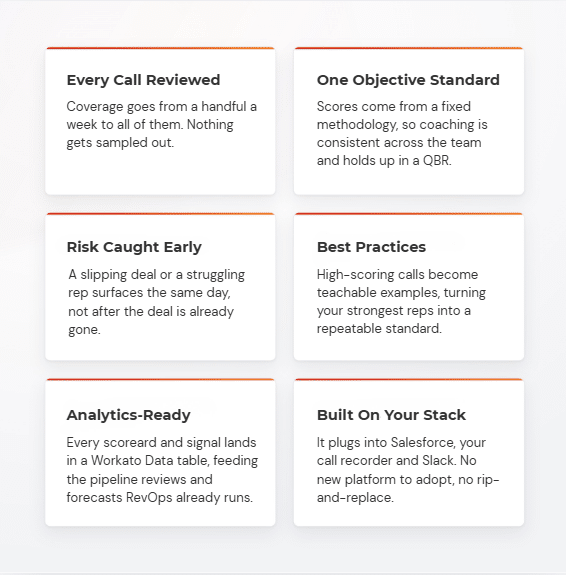
Coverage goes from a handful of calls a week to all of them, so nothing gets sampled out. Scores come from a fixed methodology, which keeps coaching consistent across the team and defensible in a QBR. A slipping deal or a struggling rep surfaces the same day, while there is still something to do about it. High-scoring calls become teachable examples, turning your strongest reps into a repeatable standard. Every scorecard and signal lands in a Workato Data Table, feeding the pipeline reviews and forecasts RevOps already runs. And the whole thing plugs into the stack you have, including Salesforce, your call recorder and Slack, so there is no new platform to adopt and nothing to rip out.
Coaching that rests on every conversation
Scoring one call well is the easy part. Scoring all of them is what changes the coaching. Feedback stops depending on which calls a manager had time for and starts resting on evidence from every conversation a rep has. The discovery call that looked fine while quietly leaking a deal becomes the one your whole team learns from, instead of the one nobody ever played back.
See what your own call transcripts score
The Sales Call Analysis Genie is one of a growing library of Genies we are building on Workato to point agentic AI at real revenue-operations work.
Curious what your team's calls are really telling you? Twenty20 Systems is a Workato Platinum Partner and Workato's North America Partner of the Year. Talk to us about running the Genie against your own transcripts.
About the Authors

Jayaram S
Meet Jayaram, our Lead Integration Engineer at Twenty20 Systems, who leads integration builds across Workato and agentic AI. With over 15 years in enterprise software and integration, he has designed and delivered API and data integration solutions for globally distributed teams, and has led integration delivery across the APAC region. His experience spans API development, data pipeline engineering, platform migrations, and application performance monitoring, giving him a clear view of how integrations behave once they are running in production. Jayaram pairs that operational depth with a builder's instinct, delivering integrations that stay reliable as the business scales.