

AppFolio Integration We Built to Automate Work Orders
September 15, 2026AppFolio Integration We Built to Automate Work Orders
September 15, 2026
Order Management Genies: AI Order Automation in Slack
A large order comes in on a Tuesday. It looks routine, so it gets approved. The account is over its credit limit, the shipping address is missing a suite number, and only three units are left in the warehouse against an order for forty. None of that surfaces at approval, because confirming it means opening the ERP, then the inventory view, then the credit report, then going back to the channel to ask a colleague. Nobody has time for that on every order, so the order moves. Two days later it comes back as a hold, a partial shipment, and a customer call. The stock, meanwhile, was always going to run out. It just ran out sooner.
Swap the details and the shape holds. A wholesale purchase order, a marketplace order, a distributor's replenishment request, a retailer's restock order: in each case the information needed to make the call is spread across several systems of record, and the decision happens somewhere else entirely, where none of that data lives.
Order Management Genies gives operations and supply chain teams two AI assistants that check incoming orders for problems before those orders reach fulfillment, and recommend what to reorder before stock runs out. Both work inside Slack, Workato GO, and other supported collaboration platforms, so the people making the decision never leave the tool they are already working in. Twenty20 Systems built the solution on the Workato platform and packaged it for the Workato Marketplace.
One assistant checks orders, the other plans stock
The Order Validation Genie reviews an incoming order end to end before anyone approves it: whether the account exists, whether the shipping and billing addresses are valid, whether required fields are missing, whether the customer carries credit risk, and whether the product is actually in stock. It also catches duplicate orders before they get processed twice.
The Order Replenishment Genie looks at stock on hand, applies demand forecasts and safety-stock rules, and comes back with reorder quantities by item and by region. It drafts the purchase orders, and procurement reviews and releases them. The recommendation is only a recommendation, nobody is handing the buying decision to a machine.
Both assistants work through conversation. Someone asks, and the answer comes back in the channel as structured output that can be acted on immediately.
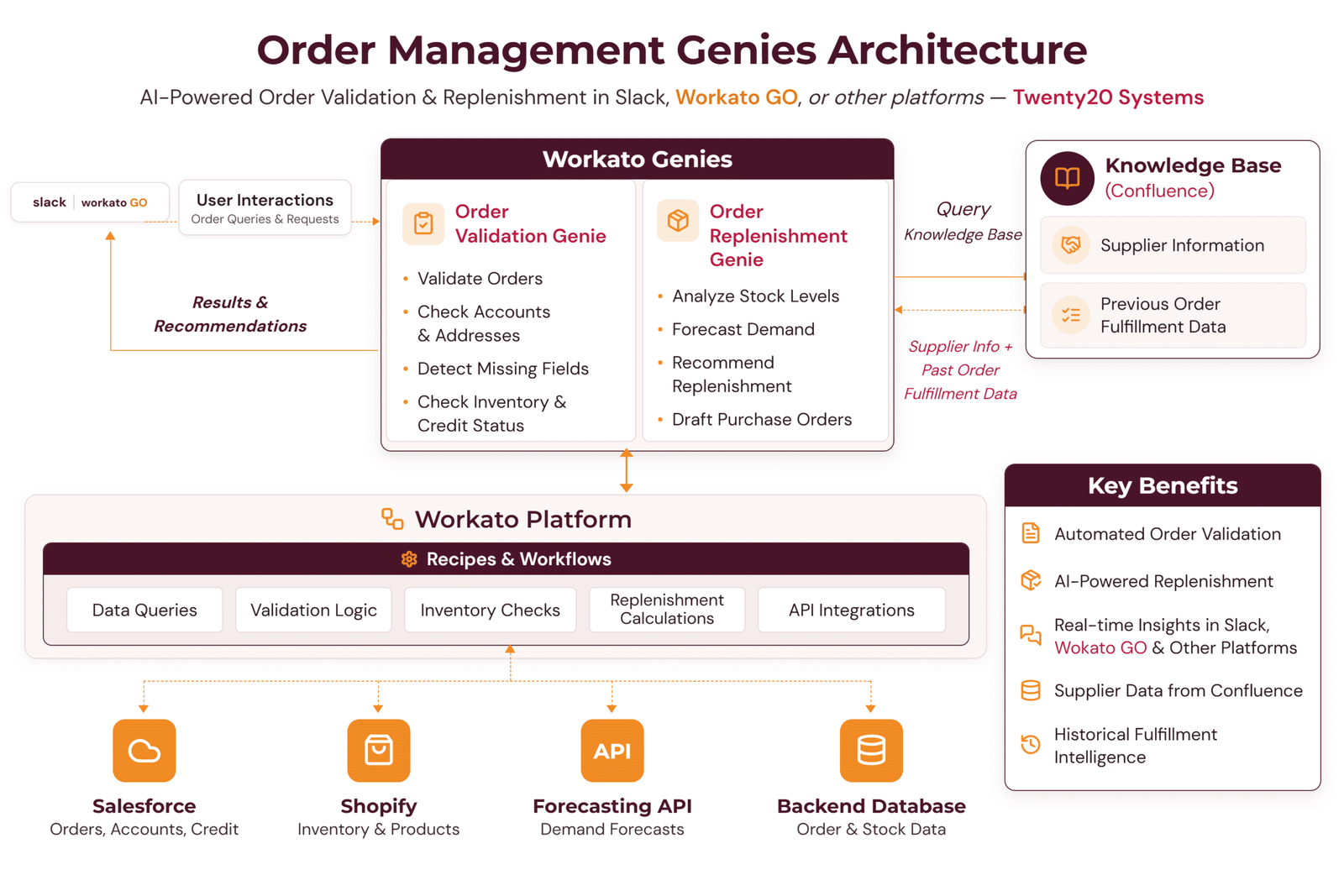
Bad orders cost the most when they are caught late
An order with a missing field or an invalid address, or one placed by a credit-risk account, is cheap to fix at submission. The same order becomes expensive once it has entered fulfillment, because unwinding it means reversing work across several systems, absorbing the shipping cost, and explaining the delay to the customer.
Those orders get through because validation is manual. Someone opens the ERP, then an inventory dashboard, then a spreadsheet, then goes back to the collaboration tool to confirm with a colleague. The individual checks are not hard. The path through four tools is what makes them slow, and slow checks under volume pressure become skipped checks.
Duplicate orders follow the same pattern. They are obvious once someone looks, and nobody has time to look at every one.
Reactive replenishment plans around stockouts instead of ahead of them
Replenishment planning tends to run on what is in the warehouse today rather than on where demand is heading. Supplier lead times, past fulfillment performance, and demand signals sit in systems and documents nobody has time to search, so the picture usually arrives after the stockout has already started.
The cost lands in two places. Stockouts lose revenue and damage retailer relationships. Overstock ties up working capital in inventory that moves slowly. Both are decisions made without a forecast in front of the person making them.
Retail, e-commerce, consumer goods, and distribution feel this first. Retail and e-commerce brands selling across storefronts and marketplaces lose margin when invalid or duplicate orders slip through and stock runs out on fast-moving items. Consumer goods brands selling through retail partners face the same risk, where an order shipped short or late can cost more than the order itself. Distributors handling high volumes of partner orders rely on manual checks that slow approvals and leave replenishment planning a step behind demand. Order Management Genies are built for that pattern: high order volume, several systems of record, and decisions that stall while someone reconciles them by hand.
The workday changes before the tech stack does
Nothing moves. The ERP, CRM, and e-commerce platform stay where they are, keep holding the orders and the inventory, and the team keeps working on its collaboration tool. What changes is that the question and the answer now happen in the same place.
A rep asks whether an order is clean and gets a verdict in the channel, with the reason attached. A planner asks what to reorder for a region and gets quantities with the forecast behind them, plus a draft purchase order ready for review. The supplier history and fulfillment intelligence that used to live in a knowledge base nobody searched now arrives inside the recommendation automatically.
For the buyer evaluating this, the practical point is that there is no new platform to stand up. The solution runs on Workato's Genie architecture and is packaged for the Workato Marketplace, so it deploys inside the same governance model, connection library, and controls a Workato customer already operates. Customer data is not persisted outside backend systems of record, and Workato handles credentials through connection management and encrypted storage.
What operations teams get back
- Order errors caught before they enter downstream systems, which cuts rework, duplicate processing, and fulfillment friction
- Credit-risk and out-of-stock orders surfaced at validation rather than mid-fulfillment, when they are cheapest to stop
- Replenishment decisions made against forecasts and stockout-risk signals rather than against yesterday's stock report
- Supplier knowledge and past fulfillment history put in front of the planner automatically
- Four-tool context switching removed from the two workflows that consume the most operational time
- Faster order-validation turnaround and faster replenishment planning, delivered conversationally
Talk to Twenty20 about a fit conversation
Order Management Genies is in Early Access and available on the Workato Marketplace. If order validation and replenishment planning currently run across four systems and a spreadsheet, a short fit conversation will tell you whether the Genies map to your workflows.
View on Workato Marketplace | Contact Twenty20
About the Authors

Meet Saravana Kumar, our CTO at Twenty20 Systems, who brings over two decades of expertise in automation, integration, and enterprise technology leadership. Saravana has consistently architected scalable solutions that transform complex business requirements into intelligent, automated systems. His deep integration expertise spans from implementing Knowledge Management solutions to leading enterprise platform delivery for customers with complex automation needs. Saravana's vision for scalable technology platforms and commitment to automated excellence drives Twenty20 Systems' innovation in enterprise integration and agentic orchestration solutions.